Photograph 49: The X-ray Watson did not see
It’s elementary, my dear Watson
The death of James Watson has rekindled a debate that has raged for decades over whether he and fellow Nobel laureate Francis Crick denied Rosalind Franklin due credit in the discovery of DNA’s structure.
A recently surfaced letter from the third man in the trio who won the Nobel prize for the double helix accuses Watson and Crick of pinching data without acknowledgement.
It candidly describes a ‘Rat Race’ in which Franklin was “got rid of” for “monopolising” data.
The letter has highlighted contemporary concerns around sexism in science and questions around the publication of research in the field.
“It is an absolute Rat Race,” Wilkins wrote in his letter to DNA supplier Leonard Hamilton, estimated date 21 March 1953. “Francis is being by no means ethical about it all using all the data & ideas he and Jim have got from here & then maintaining he has done it all by pure reason.”
In that same letter, he said of Franklin, “We have got rid of the young woman who was monopolising much of our data.”
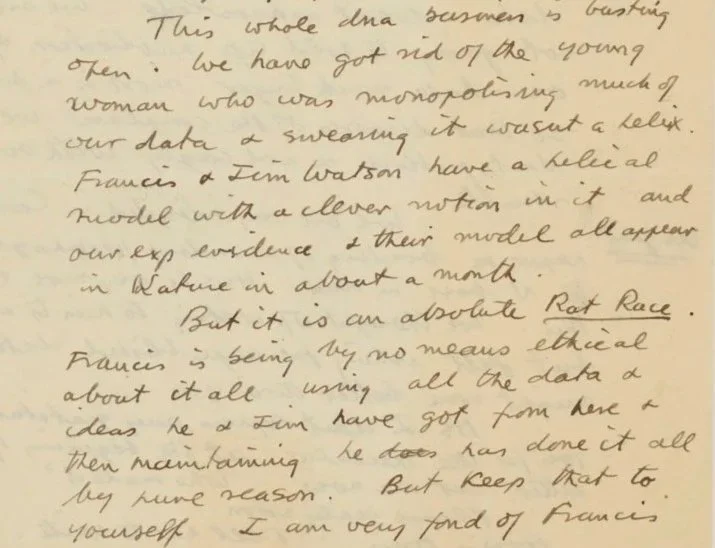
Credit: Maurice Wilkins, letter to Leonard Hamilton, 19/20 March 1953. Christie’s Inc. (Lot closed January 2023.)
The political tide has, since an opinion piece by Watson and Crick’s respective biographers Nathaniel Comfort and Matthew Cobb in Nature in 2023, turned against the idea that sexism played a role in why Franklin wasn't credited in a Nobel prize. Franklin had died by the time the Nobel prize for physiology or medicine was awarded to Watson, Crick and Wilkins for the double helix theory in 1962, but at that time there was no rule against posthumous nominations. Despite Franklin’s premature death in 1958, such a rule was not introduced until 1974.
In a separate letter to his supplier in a trove discovered 70 years after the event, Wilkins used a slur to describe Franklin, writing, “the silly bitch botched the whole business”, in the same breath that he said Franklin should be credited alongside him.
“I suggest you mention Franklin’s name too,” Wilkins conceded of the DNA work.
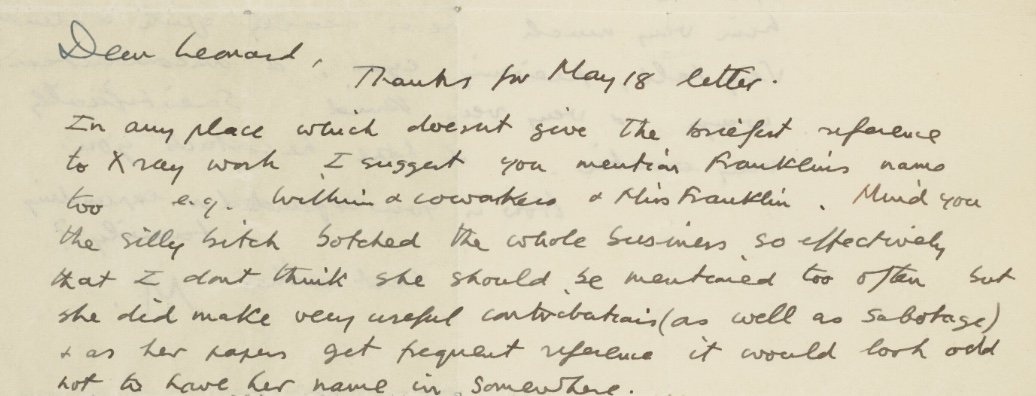
Credit: Maurice Wilkins, letter to Leonard Hamilton, 21 May 1957. Christie’s. (Lot closed January 2023.)
Franklin’s true contribution in sharp relief
These recently discovered letters have brought into sharp relief the innovative research into DNA’s structure undertaken by Rosalind Franklin, including a previously unknown X-ray photograph of the double helix than Watson was unaware of.
According to her laboratory notebooks, it was this earlier X-ray image, Photograph 49, that brought her to consider that the structure was a two-chain helix as early as February 1953, months before Watson and Crick’s paper.
Photograph 51 became infamous for forming the basis of Watson and Crick's theory, which was published in Nature journal April 1953. That transpired after the controversial American scientist revealed in his memoir The Double Helix, partially entitled, ‘A personal account of the discovery of the structure of DNA’, in 1968 that Franklin’s colleague Maurice Wilkins had shown him the X-ray image while he was visiting their laboratory at King’s College on the Strand in early 1953.
Watson described in his memoir how, “The instant I saw the picture my mouth fell open and my pulse began to race.” The image that he saw, Photograph 51, was taken on 6 May 1952 by PhD student Raymond Gosling, supervised by Franklin, who meticulously logged and analysed their findings.
A distinctive feature of that photograph, Photo 51, from their experiment 51, was that it was misaligned at the centre, professor Brian Sutton at King’s College London described in an author interview in 2019.
In 1962, nearly a decade after Photo 51 was taken, Watson and Crick were jointly awarded the Nobel prize for the double helix theory of DNA’s structure, alongside Franklin’s colleague Wilkins.
Two independent groups of scientists working at King’s College London and the Cavendish Laboratory in Cambridge, had redefined what the science community knew of the structure of the gene and how genes replicate.
Watson and Crick’s 1953 theory relied on experimental data that was published by Franklin and her PhD student Raymond Gosling alongside their paper.
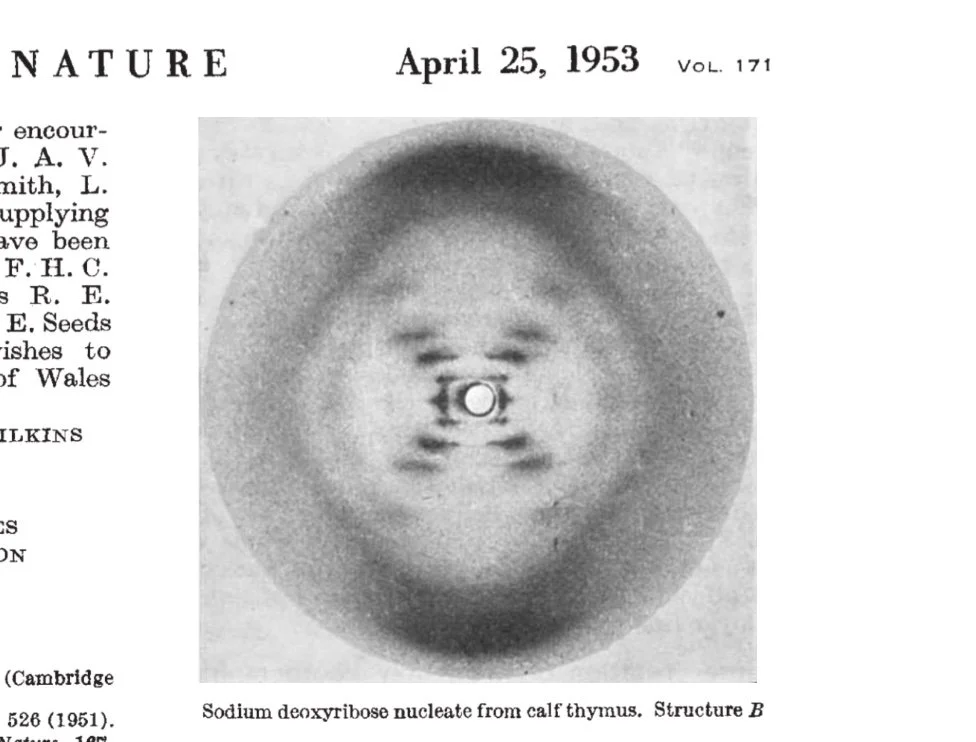
Credit: Rosalind E. Franklin, R. G. Gosling. Paper ‘Molecular Configuration in Sodium Thymonucleate’. Image shows Photo 51. Nature. 25 April 1953.
In his memoir, Watson also revealed that he and Crick had gained access to a Medical Research Council (MRC) report, containing evidence on DNA’s structure submitted by Franklin in December 1951, through Crick’s supervisor Max Perutz who was a director at the research body.
Co-laureate Wilkins himself bemoaned the apparent heist in a complaint to the head of the lab at King’s College, John Randall, in 1968, after he had found out about it from reading a copy of Watson’s memoir.
Archived documents show that Wilkins argued to head of the lab, on learning that Watson and Crick had seen their evidence on the structure of DNA prior to building their model, that the report should not have been leaked.
“If Perutz thinks that the only documents one should not show to other people are those marked “Restricted” or “Confidential”, he seems to me to be living in a funny world,” Wilkins wrote.
“I wonder how many more repercussions there will be of the Watson book?”
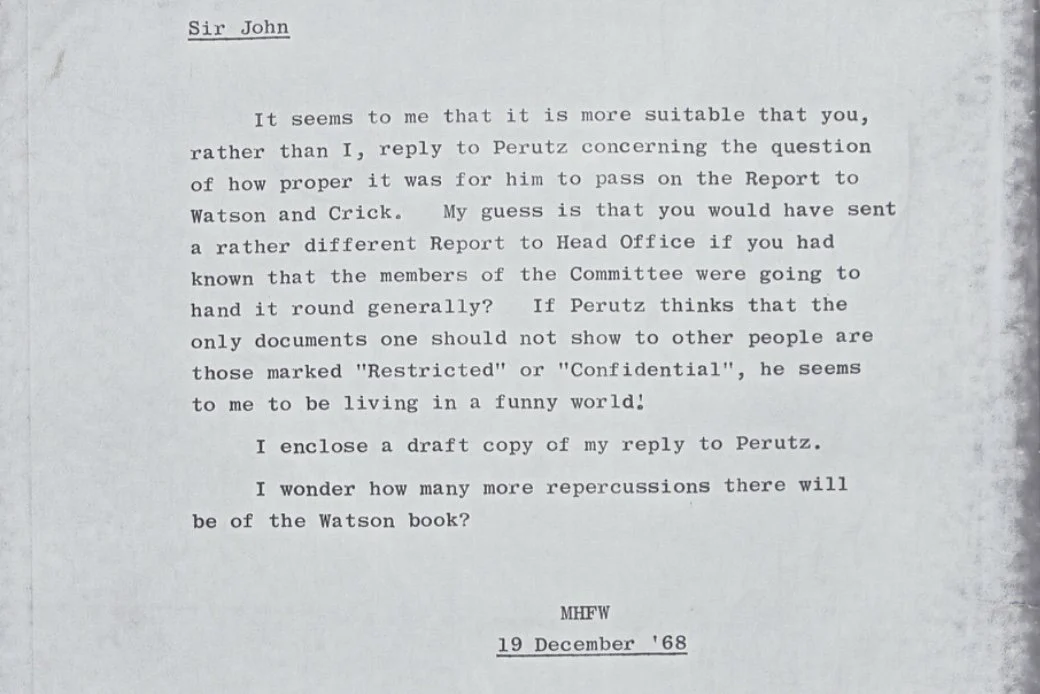
Credit: Wilkins, M.H.F. (1968) note to ‘Sir John’ (Randall). Wellcome Collection, K/PP178/3/33.
Photograph 49
Wilkins raised concerns about Crick stealing data as early as March 1953, before the double helix paper was published, despite not being aware at the time that Watson and Crick had seen the MRC report.
In the letter to his DNA supplier Hamilton, which surfaced at an auction held by Christie’s in 2023, Wilkins – who shared the 1962 Nobel prize with Watson and Crick – said unequivocally that “Francis pinches data & doesn’t acknowledge”. He added that they had “got rid of the young woman” who he claimed had monopolised the work on DNA. Indeed, she, Franklin, was in the process of leaving the lab to join Birkbeck College to investigate the tobacco mosaic virus, where she would maintain professional contact with Watson and a friendship with Crick.
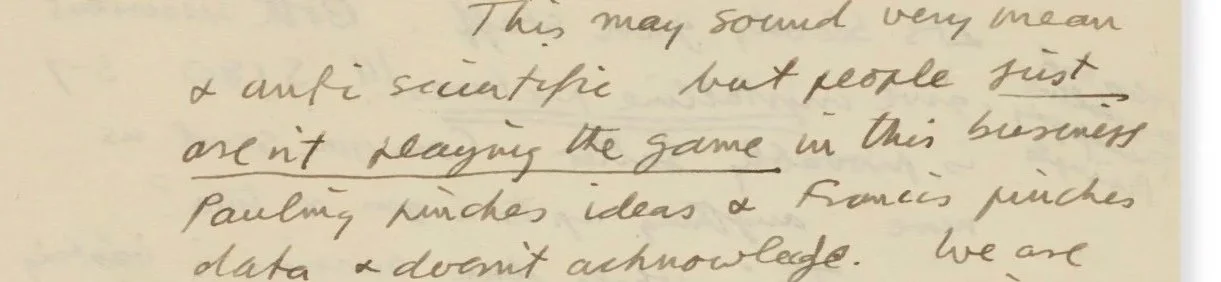
Credit: Maurice Wilkins, letter to Leonard Hamilton (P2), 19/20 March 1953. Christie’s Inc. (Lot closed January 2023.)
Recent reports have erroneously reversed years of research that has demonstrated the role Rosalind Franklin's work played as fundamental to the discovery of DNA's helical two-stranded structure. For example, a review of the latest biography by Matthew Cobb of Francis Crick in The Times described the co-Nobel winner as 'last of the lone scientific geniuses'.
The discovery of DNA's structure is often attributed to Watson and Crick, with 'Photo 51' cited as pivotal evidence in determining its molecular arrangement.
However, Photo 51 became famous because Watson described seeing it in his memoir on a visit to the King's College laboratory in the intervening days in late January and early February 1953, where he was shown a copy by Wilkins.
Crick himself said that their paper in Nature that April would not have been possible without Franklin's experimental data.
Archival records and laboratory notes demonstrate that an even earlier image of DNA by Franklin and PhD student Gosling, 'Photo 49', was critical to her deductions of DNA’s helical structure. That photograph formed the basis for most of her early independent findings.
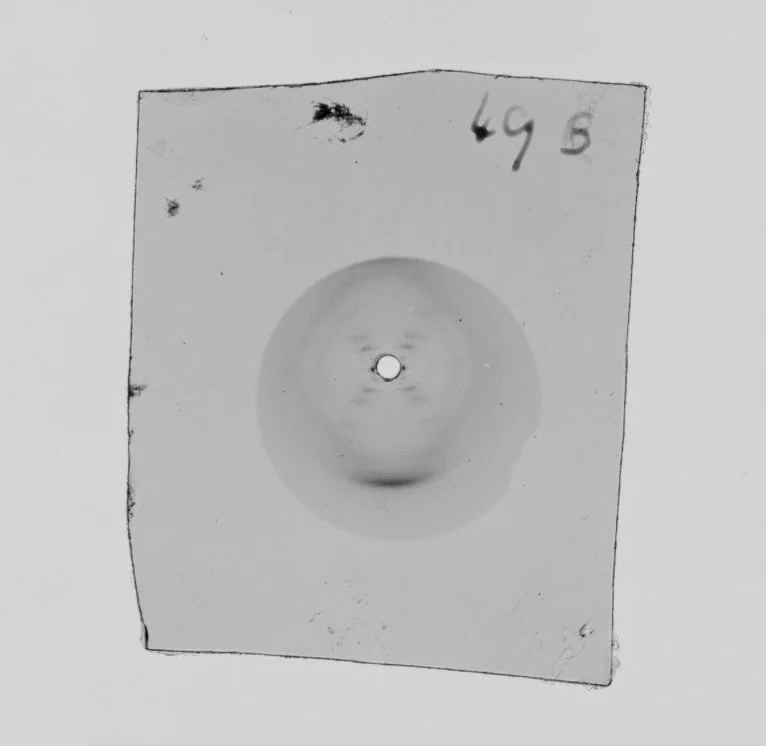
Credit: Rosalind Franklin, X-ray diffraction exposure of B-type DNA referenced as "49b. Structure B. Eqt (dbt) XR 46". Wellcome Collection. March 1953. Reference: KDBP/1/1/0868.
It was data from Photo 49, which according to her laboratory notebooks from 1952 and 1953, formed the basis for Franklin’s theoretical speculation that DNA was likely shaped as a two-chain helix, months before Watson and Crick’s paper.
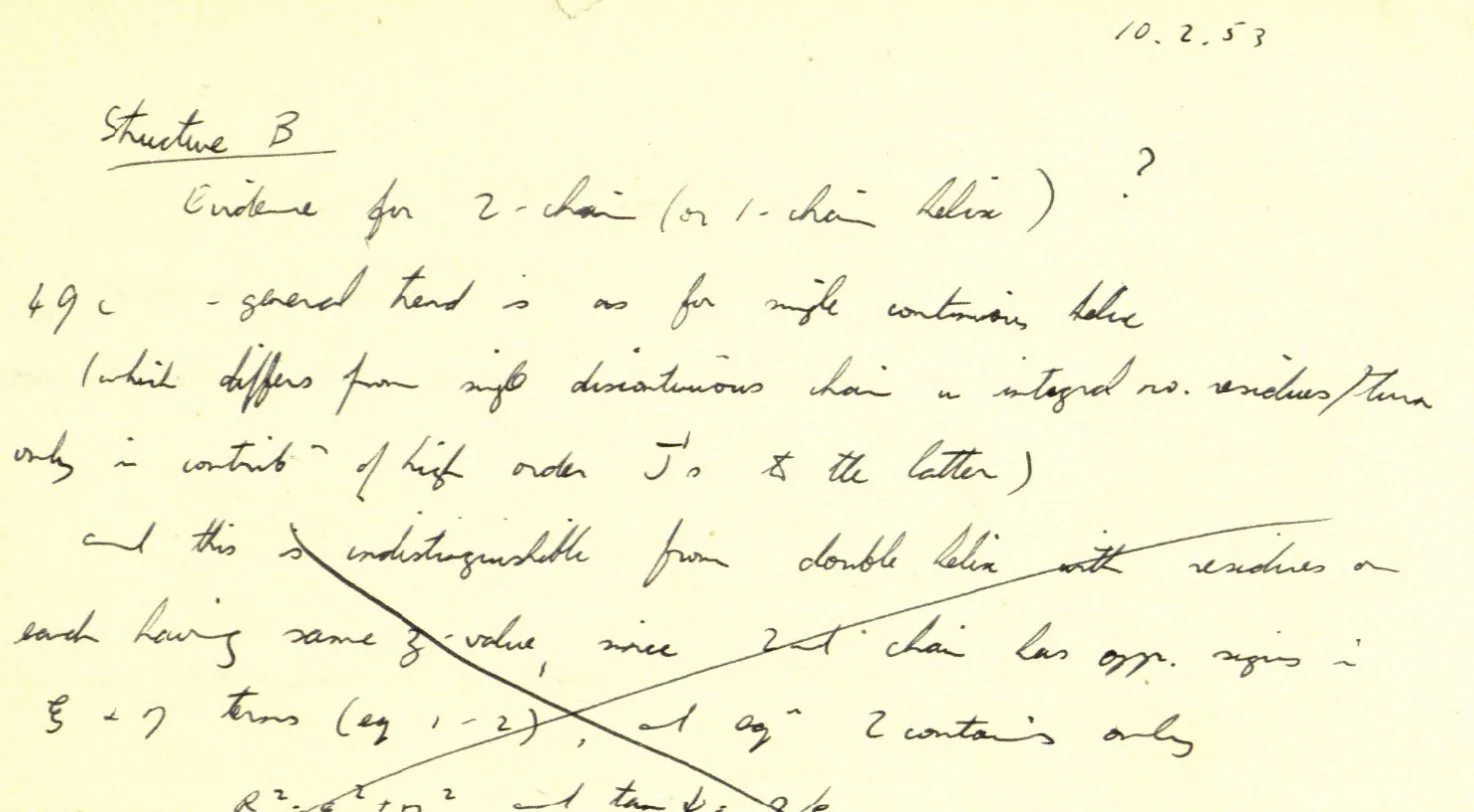
Credit: Rosalind E. Franklin, Research on DNA. Date: 1951-1953. (10 February 1953, 1953 Notebook.) Wellcome Library. Reference: FRKN 1/1.
Chance discovery
The historical record reveals that Photo 49 was at least as, if not more, significant historically as Photo 51, which Wilkins showed to Watson without Franklin’s consent.
On the evening of 1 May 1952, Franklin and Gosling took a perfectly aligned photo of the double helix, a very good “wet” photo showing the Maltese cross commonly associated with Photo 51. This X-ray photograph was Photo 49.
According to Franklin’s ledger of their experiments, that photo was taken about a week before ‘Photo 51’, which used the same specimen of calf thymus DNA fibres that demonstrated an ‘irreversible’ change from crystalline to B DNA in structure.
Her experimental ledger shows Photo 51 was taken using the same specimen as this earlier photograph, in a long exposure over the weekend of May 1952 that lasted 62 hours. Experiment 51 suffered an interruption of 32 hours, which word of mouth at the King’s College archives suggests could have been due to a blackout over the stormy May bank holiday weekend.
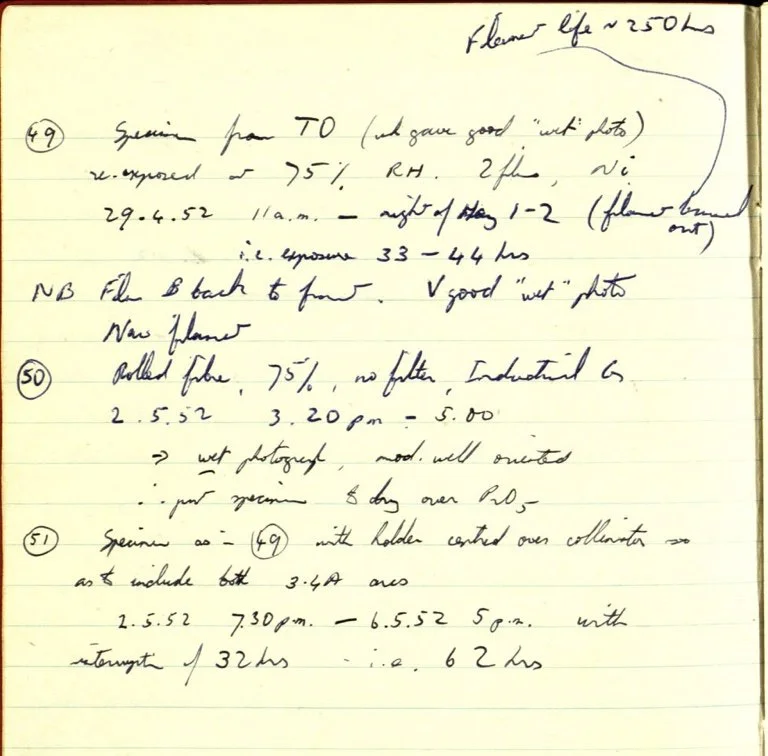
Credit: Rosalind E. Franklin, Research on DNA. Date: 1951-1953. (1-6 May 1952, 1952 Notebook.) Wellcome Library. Reference: FRKN 1/1.
By early February 1953, Franklin had come to the conclusion, from examining Photo 49, that DNA was likely to be a double helix. She began to describe her evidence in her 1953 laboratory notebook, on 10 February, for what she called a possible '2-chain’ helix, denoting the spiral shape of the molecule.
Writing around the summer of 1952 in her lab notebook from that year, Franklin said, “there is an integral” number of residues per turn of a helix.
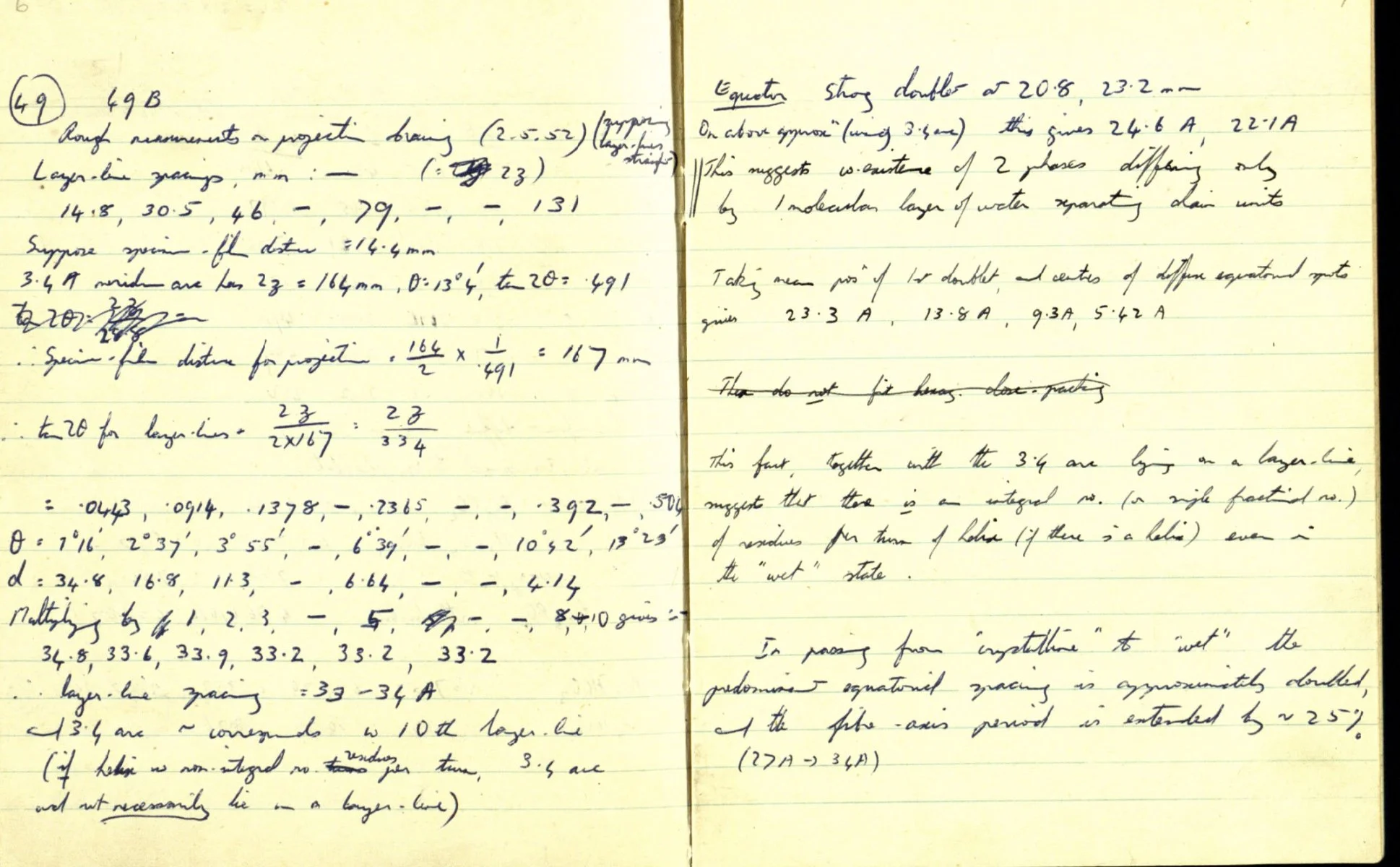
Credit: Rosalind E. Franklin, Research on DNA. Date: 1951-1953. (Circa 2 May 1952, 1952 Notebook.) Wellcome Library. Reference: FRKN 1/1.
At higher levels of moisture, DNA was effectively in its natural habitat.
The discovery that DNA changed irreversibly when water-logged was happenstance as a result of a series of experimental mishaps.
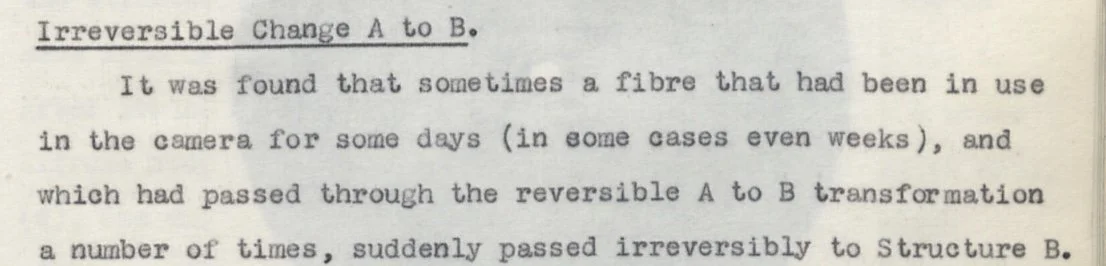
Credit: KCL Department of Biophysics: PhD Thesis by Raymond Gosling 'X-ray diffraction studies of Deoxyribose Nucleic Acid'. (P66). Wellcome Collection. Gosling, Raymond, b. 1926. Date: 1954/ Reference: KDBP/5/1.
As Gosling said in page 66 of his thesis in 1954, “sometimes a fibre that had been in use in the camera for some days (sometimes even weeks)... suddenly passed irreversibly to Structure B”.
Photo 51 was one such image; taken as a series of experiments controlled at 75% humidity, almost the same as in the human heart, lungs and brain (73%), it became one of the clearest X-ray photos of the double helix in science history. Further experimentation showed that the irreversible change happened at even higher relative humidity of 92%.*
Incredibly, the process involved a 32-hour interruption over the May bank holiday weekend of 1952, according to Franklin’s description in her 1952 lab notebook.
In an exposure that began before the early May bank holiday, they had taken an almost exact replica of Photo 49 that set the cogs in motion that rewrote scientific history.
Neither were the first such image, as Elwyn Beighton, working in the lab of William Astbury, had taken a similar image the year before, but Franklin’s methodical data and deductions helped unravel the mysteries of DNA, underpinning the double helix theory.
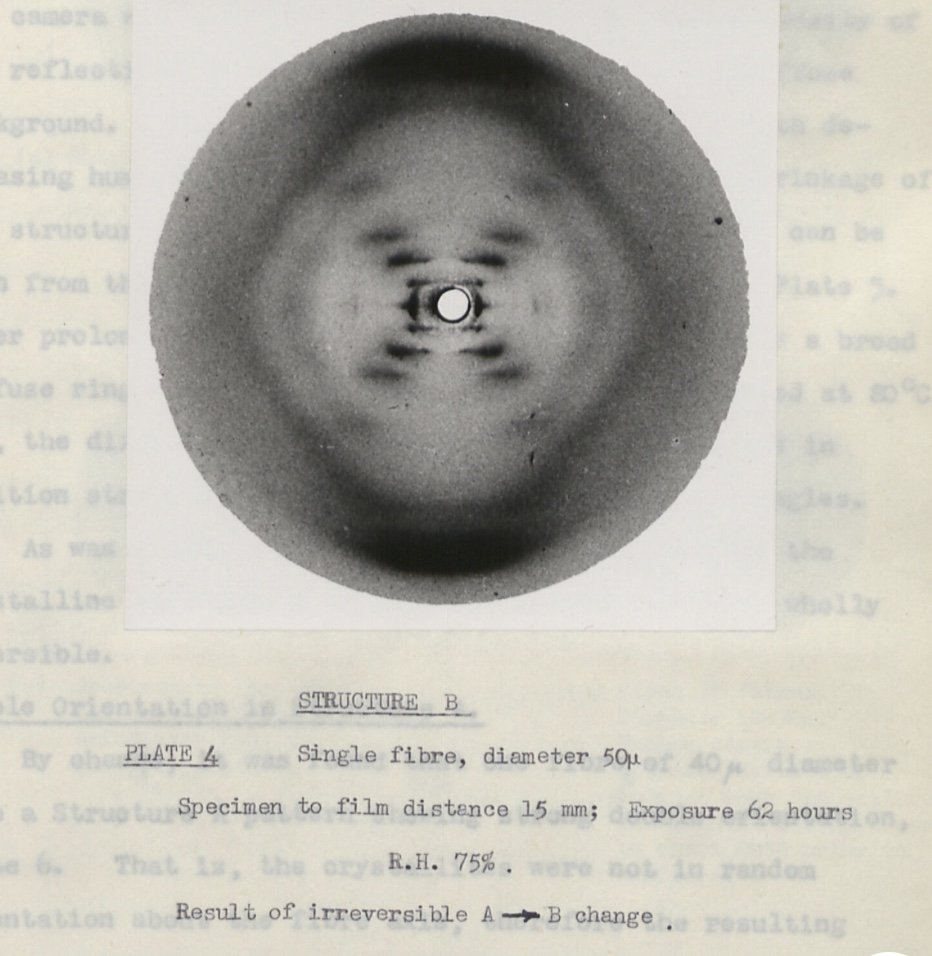
Credit: KCL Department of Biophysics: PhD Thesis by Raymond Gosling 'X-ray diffraction studies of Deoxyribose Nucleic Acid'. (P66/67.) Gosling, Raymond, b.1926. Date: 1954. Wellcome Collection. Reference: KDBP/5/1.
That prior November in 1951, Watson himself recalled in Chapter 13 of his memoir that Franklin had corrected his and Crick’s erroneous three-chain model, after he had failed to recall the details of her lecture correctly.
Franklin's notebooks from 1952 and 1953 show that she deduced much of the structure of DNA from Photo 49 (notebook entries 49b from 1952 and 49c in 1953), positing a '2-chain' helix weeks before she and her colleagues had learned of Watson and Crick's model. Wilkins responded in a letter to the news that day, on 18 March 1953, calling them a "couple of rogues".
Photo 51 was, archived photographs and records show, an almost exact, but skewed, replica of Photo 49, showing an 'irreversible' change from A BNA to B DNA.
They were so similar, in fact, that in the absence of repeating the parameters of the experiment shown in Plate 4 (above), or modifying the punch hole, Gosling may have mislabelled another reproduction such as Photo 49 in his thesis as the now infamous 62-hour exposure (see Plate 10 below).
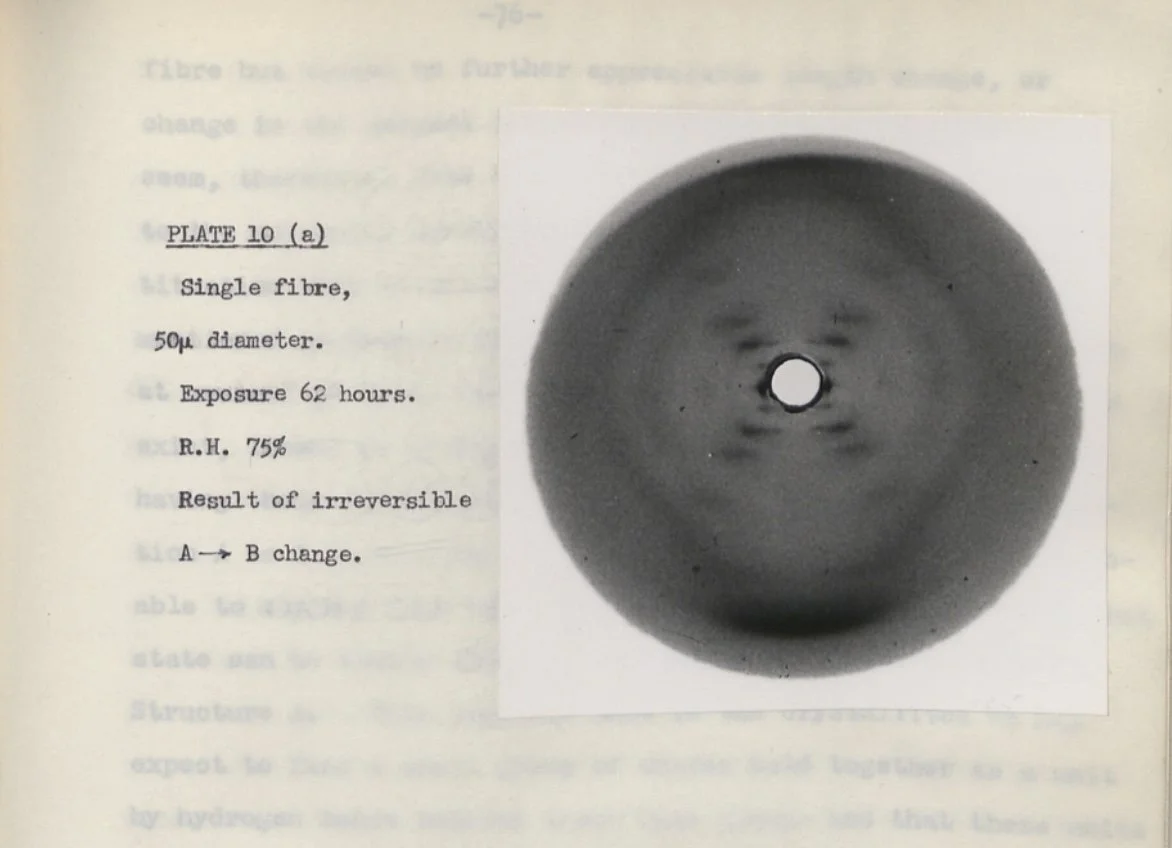
Credit: KCL Department of Biophysics: PhD Thesis by Raymond Gosling 'X-ray diffraction studies of Deoxyribose Nucleic Acid'. (P76.) Gosling, Raymond, b.1926. Date: 1954. Wellcome Collection. Reference: KDBP/5/1.
Rosalind, published last year, spotlighted the role that Photo 49, an earlier and lesser known photograph of the double helix, played in the discovery that DNA was helical.
* Gosling hypothesised in his thesis that DNA fibres underwent the irreversible, rather than reversible, transition from crystalline to ‘wet’ at about 92%. On p65, he wrote that, “When, with the same specimen, R. H. 92% was approached from the wet side the resulting diffraction pattern indicated a complete structural change, showing only Structure B.” On P85 he wrote, “Structure B does not occur alone, in fibres showing the A to B change, at humidities lower than 92% R. H.” In further clarification on P72, he described how “the pellets used for determinations at 75% R. H. were maintained at a relative humidity of 92% for more than nine weeks”, as the “water content of the pellets was always lower than that of the fibres at the same humidity”.
Special thanks to Michael Peel, science editor at The Financial Times, for contextualisation, professor Brian Sutton for interviews, and editor Cari Rosen, and my publisher, with whom I shared details of the Hamilton letters (from the Christie’s archive).
Jessica Mills Davies is the author of ‘Rosalind’, which published by Legend Press in the UK in February 2024, and ‘The English Chemist’ that debuted in the US by Pegasus Books of New York in September. She is a Senior Correspondent (London) at DC Thomson.